Hey thanks for coming back for more of my scribblings. This morning brought another flying lesson with it.
This lesson included spiral dives and an air exercise called 'Slipping'. Spiral Dives can happen in a few different ways, but most of these ways occur because the pilot wasn't paying attention or because the pilot became momentarily disoriented, which can occur when a pilot who's untrained in flying into clouds, flies into a cloud.
Spiral dives aren't as scary looking as spins, but can be more dangerous due to the nose down attitude of the airplane, and rapidly increasing air-speeds. If one isn't careful in gently pulling out of a spiral, or doesn't recognize when a spiral is happening, the airframe of the airplane can become stressed to the point of critical damage due to the high airspeeds and add G forces. You can read more about spiral dives here if you wish. Spiral dives were a fun exercise for me to practice, even though it was probably the most dangerous exercise to attempt.
When it comes to 'slipping', there are a few different types. Slipping is a maneuver in which the pilot uses cross controls (left rudder pedal and right aileron input, or vice versa) in order to accomplish either a fast loss of altitude without threat of damage to the airframe, a turn while needing to lose altitude quickly, or as a technique for landing with a crosswind ( a wind that is not directly aligned with the runway, but is instead approaching the airplane from either side). You can read more about side slips and forward slips here.
It's a good thing we practiced the latter, because during today's approach and landing I did encounter some cross-wind, and I did have to perform a side-slip landing. A side-slip landing looks something like this, except the guy in this video did a heck of a job landing the airplane. My landing was a bit rougher but I was still pretty happy with it, taking into account it was my first slide-slip try, and I was quite surprised by the amount of input you have to apply on the controls. Take a look at the movement of the flight stick in this video:
It really is a fun way to land, but you do have to be on top of your game, as the wind direction and strength change, so do your flight control inputs. As well, during a slide-slip landing, the landing is preformed with only one of the wheels touching down first due to the configuration of the side-slip.
My apologies if this is getting too technical for some. I only speak this way because I don't have much else to talk about. Though there was a couple of other things that are worth mentioning.
I was assigned an airplane this morning with the callsign FFHH (that's Foxtrot Foxtrot Hotel Hotel), quite the tongue twister for a beginner pilot such as myself. I did the walk around checklist, made sure everything is fine, we got in the airplane, turned the engine on, and a weird sound was audible. I mentioned it to my instructor, and he instructed me to turn off the engine as he took a look outside. He came back and said that we're not going to fly that airplane today. He proceeded to show me what was wrong - two pieces of metal that looked like they were harnessing the prop, or maybe just covering it, were lose. I saw two screws missing. and the parts were lose. It was probably nothing, but it was creating the sound we heard, and since we were going to practice some extreme flying, it was probably best to have the engineers take a look at the airplane.
So we got another airplane with the call-sign Echo Yankee Whiskey. I was glad we got another airplane, only because I wouldn't have to repeat Foxtrot Foxtrot Hotel Hotel on the radios again. Whew.
What's up next? Well, I have a check-ride next lesson. That's when another instructor takes me up, and monitors my progress on everything I've learned up to now. It's not a test, more of a progress report. I'm looking forward to hearing someone else's point of view on how I'm progressing.
It's also crunch time for me to take my radio license test and my PSTAR test, as my solo flight is coming up. Yes, my solo flight. I'm 12.5 hours in, and my instructor is talking to me about flying solo. Should be fun times coming up, I'll keep you posted.
Tuesday, October 19, 2010

Wednesday, October 13, 2010
Brrrrrrr, & I did it!
I did it! Another milestone accomplished. Today I practiced spins.
The day started off with a 5:45am wake-up call, for a lesson start time of 7:00am. However, it's not the way things turned out. I got to the airport at 6:45am. It was still dark outside. I had to wait until sunrise in order to be able to fly legally. Not only that, but temperatures hit zero degrees overnight last night, and that means frost - or in aviation terms - icing.
 Icing on an airplane. Image taken from Wikipedia
Icing can occur on any part of the surface of the airplane including the wings, dashboard, and even inside the engine during certain atmospheric conditions. In Canada this usually happens in the winter during freezing conditions. Icing can look like - and sometimes is - frost. There are other types of icing that are an actual accumulation of ice on the wings and body of the airplane. What I experienced this morning was frost. It was about 1/4 inch of frost. If we were to try to take off with that amount of frost on the airplane's surfaces, there's a good chance we would stall on takeoff, and, well, crash. Flying with icing is a big no no as the airplanes we fly are not certified for icing conditions. You can read more about icing here.
How do we get rid of icing? Usually a deicing liquid is sprayed on the whole airplane. It is a sticky orange liquid that removes ice, and also prevents ice from accumulating on the airplane surfaces during flight. You might have experienced a deicing on airliners in flights from Toronto (or any other cold place) during the winter. The airliners have to deice as close to takeoff as possible, and the captain would usually announce this.
 Spraying deicing fluid on an airliner. Image taken from Wikipedia
However, since it is still October, the airport flight-line services didn't have their de-icing equipment ready. Eric the instructor and I had to resort to removing frost with a credit card (as scrapers aren't allowed). Then wiping down the water with paper towels. The sun that eventually came up helped melt the frost as well. This took up the best part of an hour.
So, after waiting for the sun to come up, and manually deicing the plane, we were finally up in the air at around 9:00am. I climbed the airplane to 5,000 feet, when Eric told me to perform the checklist for spins.
I've tried to get myself mentally ready for spins for the past few days, but it's hard to convince oneself of the idea of purposefully creating conditions where you're piloting an airplane that's spiraling towards the earth.
Eric performed the first spin. As I wrote in my last post, Eric showed me a couple of spins the last lesson. So at least I was ready for what was going to happen. During the spin that he preformed, I noticed myself paying attention to the way he moved the flight controls, knowing I would have to preform the next spin.
The demo spin came and went. We lost about 600 feet in a matter of seconds. We straightened out as I heard Eric say "Ok, are you ready?" to which I responded "I don't know, am I?" to which Eric responded "Yes."
I took control of the airplane, breathed in deeply, and went for it. I proceeded to first stall the airplane (a requirement in order to enter a spin). Once the stall horn came on, I pushed the rudder pedal all the way to the left, and bam, we're upside down hurling towards the earth, kaleidoscope windshield and all.
I'll pause here to mention that for some reason, my spins we're quicker and more intense than the ones my instructor preformed. By that, I mean that the corkscrewing actions - or spins - were tighter and the rotation got tighter more quickly.
I learned that when you preform a spin, there is a point at which you feel that there is no way you're getting out of this situation - an airplane that is spiraling towards the earth, in which you feel like you have no control over. However, I proceeded to push on the right rudder pedal all the way, and the rotations slowly stopped and the airplane eventually leveled off. It was intense. I did it. It's one of the things I considered a milestone on the road to becoming a pilot. I never got into flying to do this type of thing, but it's a reality - something you have to go through in Canada if you want to become a pilot. I did it, and it was intense and amazing and all of the other words people use to describe something so fulfilling to the soul.
We proceeded to climb back up to 5,000 feet and do another spin.
As I stated above, I considered spins as a milestone for myself. I'm not sure every student pilot does. I think I considered it a milestone because I was somewhat fearful of it. It's that point at which a lot of people decide to not continue their lessons. But knowing that spins are the absolute worst thing that can happen to a pilot (when it's inadvertent), it feels great to know that I now know how to get out of one. And I can't wait for my next lesson.
On a personal note (as if, this whole blogging exercise is nothing but a self-bloating externally propelled internal fart), it's days like these that make me so thankful that I chose to take on learning how to fly. Where last year I felt that I was stuck in certain areas of life, lessons like this make me feel that I'm progressing, liberated, chasing something I want so badly. I have people around me to thank, as I'm not sure I would have had the courage to undertake flying without continued support from my family, girlfriend, and friends.
As for the blog? I hope that it's entertaining for you, at the very least. I started writing it mostly because I know that I will want to remember all of these experiences in detail. I could have written a diary, but that's so Anne Frank. I realize that I get overly emotional on this blog sometimes, but that's just the adrenaline talking. I hope I don't get too personal on this blog for you as to make it awkward. I'm just trying to convey my experiences onto cyber-paper. As always, thank you for reading and for your continued support. ;)
The day started off with a 5:45am wake-up call, for a lesson start time of 7:00am. However, it's not the way things turned out. I got to the airport at 6:45am. It was still dark outside. I had to wait until sunrise in order to be able to fly legally. Not only that, but temperatures hit zero degrees overnight last night, and that means frost - or in aviation terms - icing.
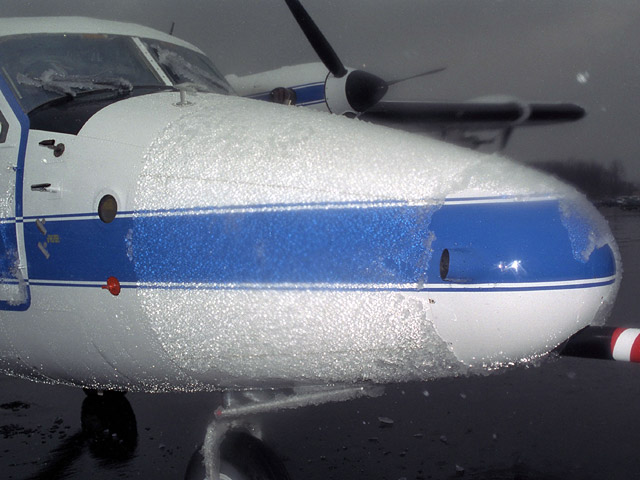 Icing on an airplane. Image taken from Wikipedia
Icing can occur on any part of the surface of the airplane including the wings, dashboard, and even inside the engine during certain atmospheric conditions. In Canada this usually happens in the winter during freezing conditions. Icing can look like - and sometimes is - frost. There are other types of icing that are an actual accumulation of ice on the wings and body of the airplane. What I experienced this morning was frost. It was about 1/4 inch of frost. If we were to try to take off with that amount of frost on the airplane's surfaces, there's a good chance we would stall on takeoff, and, well, crash. Flying with icing is a big no no as the airplanes we fly are not certified for icing conditions. You can read more about icing here.
How do we get rid of icing? Usually a deicing liquid is sprayed on the whole airplane. It is a sticky orange liquid that removes ice, and also prevents ice from accumulating on the airplane surfaces during flight. You might have experienced a deicing on airliners in flights from Toronto (or any other cold place) during the winter. The airliners have to deice as close to takeoff as possible, and the captain would usually announce this.
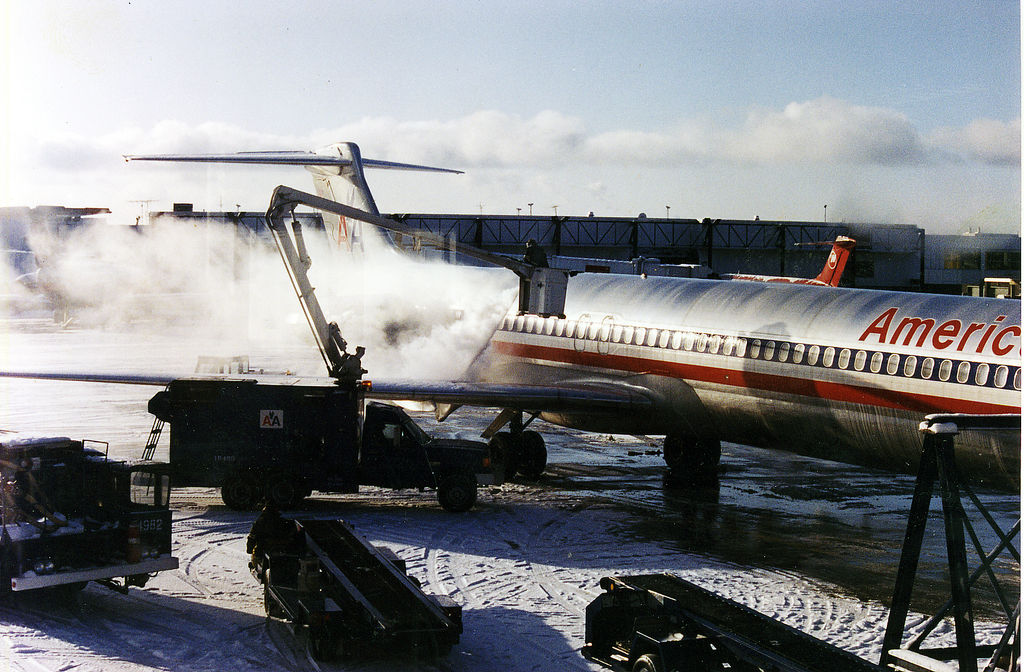 Spraying deicing fluid on an airliner. Image taken from Wikipedia
However, since it is still October, the airport flight-line services didn't have their de-icing equipment ready. Eric the instructor and I had to resort to removing frost with a credit card (as scrapers aren't allowed). Then wiping down the water with paper towels. The sun that eventually came up helped melt the frost as well. This took up the best part of an hour.
So, after waiting for the sun to come up, and manually deicing the plane, we were finally up in the air at around 9:00am. I climbed the airplane to 5,000 feet, when Eric told me to perform the checklist for spins.
I've tried to get myself mentally ready for spins for the past few days, but it's hard to convince oneself of the idea of purposefully creating conditions where you're piloting an airplane that's spiraling towards the earth.
Eric performed the first spin. As I wrote in my last post, Eric showed me a couple of spins the last lesson. So at least I was ready for what was going to happen. During the spin that he preformed, I noticed myself paying attention to the way he moved the flight controls, knowing I would have to preform the next spin.
The demo spin came and went. We lost about 600 feet in a matter of seconds. We straightened out as I heard Eric say "Ok, are you ready?" to which I responded "I don't know, am I?" to which Eric responded "Yes."
I took control of the airplane, breathed in deeply, and went for it. I proceeded to first stall the airplane (a requirement in order to enter a spin). Once the stall horn came on, I pushed the rudder pedal all the way to the left, and bam, we're upside down hurling towards the earth, kaleidoscope windshield and all.
I'll pause here to mention that for some reason, my spins we're quicker and more intense than the ones my instructor preformed. By that, I mean that the corkscrewing actions - or spins - were tighter and the rotation got tighter more quickly.
I learned that when you preform a spin, there is a point at which you feel that there is no way you're getting out of this situation - an airplane that is spiraling towards the earth, in which you feel like you have no control over. However, I proceeded to push on the right rudder pedal all the way, and the rotations slowly stopped and the airplane eventually leveled off. It was intense. I did it. It's one of the things I considered a milestone on the road to becoming a pilot. I never got into flying to do this type of thing, but it's a reality - something you have to go through in Canada if you want to become a pilot. I did it, and it was intense and amazing and all of the other words people use to describe something so fulfilling to the soul.
We proceeded to climb back up to 5,000 feet and do another spin.
As I stated above, I considered spins as a milestone for myself. I'm not sure every student pilot does. I think I considered it a milestone because I was somewhat fearful of it. It's that point at which a lot of people decide to not continue their lessons. But knowing that spins are the absolute worst thing that can happen to a pilot (when it's inadvertent), it feels great to know that I now know how to get out of one. And I can't wait for my next lesson.
On a personal note (as if, this whole blogging exercise is nothing but a self-bloating externally propelled internal fart), it's days like these that make me so thankful that I chose to take on learning how to fly. Where last year I felt that I was stuck in certain areas of life, lessons like this make me feel that I'm progressing, liberated, chasing something I want so badly. I have people around me to thank, as I'm not sure I would have had the courage to undertake flying without continued support from my family, girlfriend, and friends.
As for the blog? I hope that it's entertaining for you, at the very least. I started writing it mostly because I know that I will want to remember all of these experiences in detail. I could have written a diary, but that's so Anne Frank. I realize that I get overly emotional on this blog sometimes, but that's just the adrenaline talking. I hope I don't get too personal on this blog for you as to make it awkward. I'm just trying to convey my experiences onto cyber-paper. As always, thank you for reading and for your continued support. ;)
Monday, October 4, 2010
Stalls, Spins, and Animal Cruelty
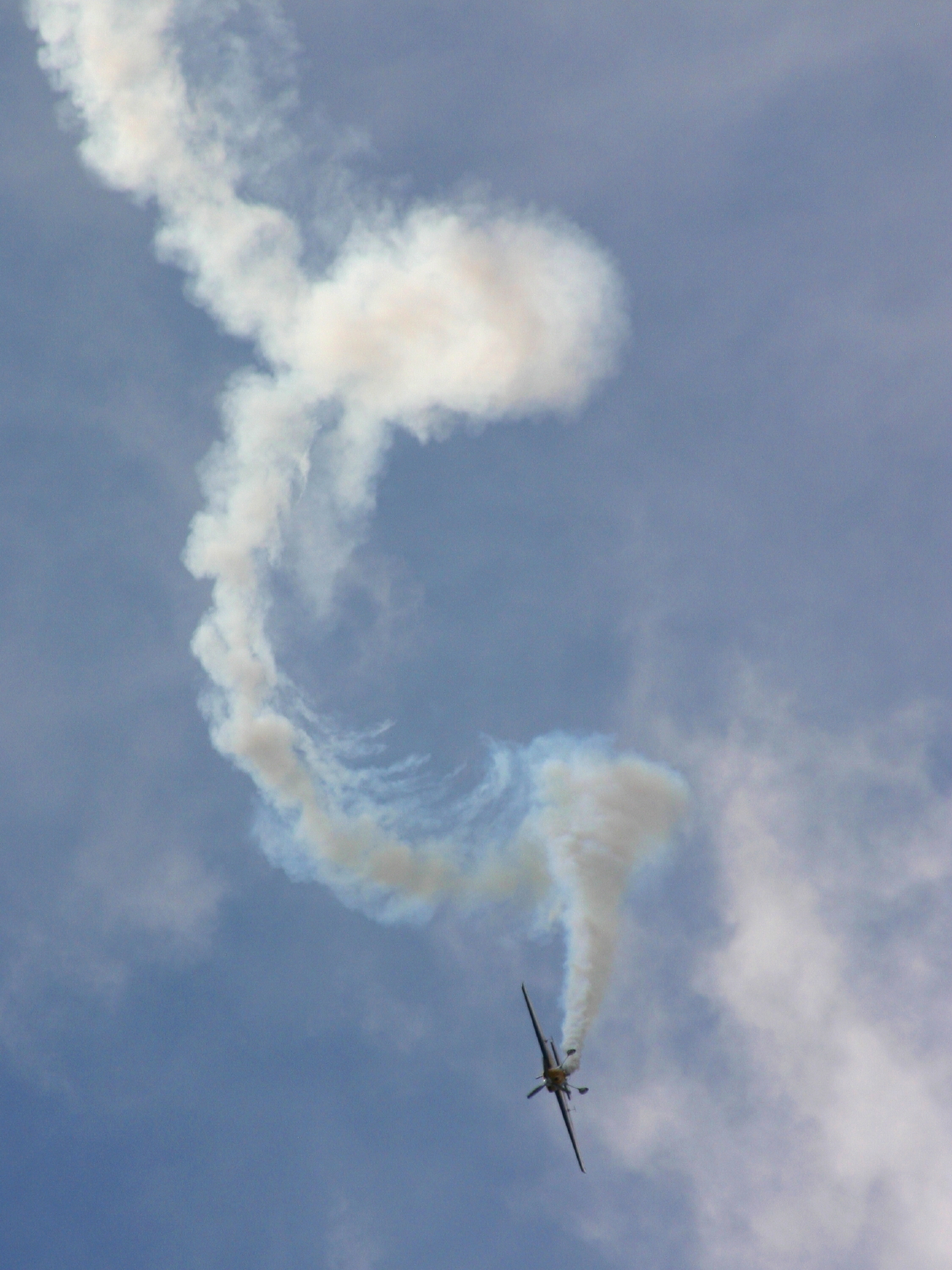 Saturday afternoon brought another flying lesson. The lessons are starting to become a little bit hard to define, as I am starting to review and practice all kinds of air exercises that I have already been introduced to. However, there's always more new things to learn, and boy did I learn on Saturday.
This lesson comprised mostly of different types of advanced stalls. Yes, an airplane can stall in more ways than I ever had nightmares of. Some of the stalls are power-off (idle engine) stalls, power-on (engine at about cruise power) stalls, turning stalls, etc. We practiced those three stalls in particular, but there are numerous more stalls that can occur.
However, the most notable thing for me this lesson was that I got to experience a spin. Two, in fact. A spin can be defined as an aggravated stall, or a stall in which the airplane is not "coordinated". This results in something called an auto-rotation, which is basically the airplane spinning. Here is what Wikipedia has to say about spins.
And here are some of the best examples of spins that I found on Youtube. The first being a video of a spin filmed from another airplane:
The second is a spin experienced from inside the cockpit:
And the third is animal cruelty, plane and simple:
Yes, what you saw above was a floating dog due to zero gravity derived from the nose-dive spin. I won't comment much about that except to say that spin checklists implicitly state that everything must be tied down and secure when practicing a spin.
I will describe experiencing spins as a very humbling experience. The forces I felt on my body and the things I saw with my eyes felt very unnatural as far as being a land mammal. Before I go on, please be aware that practicing spins is considered to be a safe exercise in the Cessna 150. Nonetheless, it does take some getting used to. In this lesson, my instructor just showed me what a spin is like. I was told to sit back and enjoy. So I didn't get myself into any actual spins, but next lesson I will have to.
As you saw in the video, one has to raise the nose of the airplane until it stalls. In order to aggravate the stall, one of the rudder pedals is pushed all the way in in either direction, so that the airplane will enter the spin.
Entering the spin was probably the strangest feeling I've felt. It feels like you're flipping backwards, with your stomach going into your throat, and before you know it, you're in a nose dive, while the colours of the autumn leaves of the Canadian landscape start to create a kaleidoscope effect on the windshield once the airplane begins to corkscrew its way towards the earth.
Sounds dramatic? Well, it was for me. It's not an experience many people think they'd go through in their lifetime, but I asked for it. Not only did I ask for it, but I have to get used to spins, as next lesson I will have to practice them myself.
Have you ever stood on a balcony while it occurred to you that if you had a tiny lapse of reason, you can just jump over the balcony without having the chance to correct your mistake? Me neither, but it did occur to my friend once... Anyway, I compare practicing spins to jumping off the balcony, except getting the chance to apply corrective actions in order to stop yourself from plummeting to the ground. As such, you can now probably understand why doing spins in an airplane would invoke such strong feelings.
My instructor said that this lesson is the point at which some of his students never return for another lesson. Although I'll admit that it was a bit of a frightening experience, I'm determined to go back for more. The way for me to look at it is that it is a safe exercise that's practiced by many pilots each day. You don't hear of very many crashes involving accidents due to students practicing spins. So there. In fact, after my instructor demonstrated the first spin, I asked him to show me another one, since I knew I'd have to get used to it sooner or later.
In other news, we practiced more stalls, steep turns, which i accomplished satisfactorily this time around, and we also practiced a maneuver called a "side-slip", which I will be covered in an upcoming lesson, as well as an upcoming post. I also managed to have quite a violent landing this time. Although it really didn't seem all that big of a deal after experiencing spins. Landing definitely seems like a delicate art which I will have to master. I'll probably have an easier time once I actually go through the lesson about landing.
Anyway, there's more stories to tell from the last lesson, but this post is getting long, and I need to get back to work. But stay tuned for my next post, as I tell tales of my adventures aloft.
Monday, September 27, 2010
Flying keeps me grounded
Another week, another lesson learned. This week, I was supposed to learn how to enter, recognize, and get out of 'slow flight'. However, we ended up doing two lessons in one this week. The other lessons was stalls.
I'll start out with trying to explain some characteristics of slow flight. Slow flight generally exists right after an airplane takes off, and right before it lands. It's defined as the airspeed below the endurance speed, but above the stall speed. Some of the characteristics of slow flight include slow airspeed, high RPMs (engine output rate), and sluggish performance of the flight controls. For those of you who are interested in the details, you can read more about slow flight here.
I found that flying an airplane in slow flight feels like a whole new way of flying. As stated above, the flight controls act sluggish and different. It's useful to practice slow flight in case a pilot finds themselves in a situation where they mistakenly enter slow flight, they'll then know how to safely exit out of it.
I haven't made a joke so far.
We practiced slow flight for a bit, and then it was time to do stalls. STALLS. That's a word that people hear and don't normally associate with airplanes. Unlike earth vehicles such as cars, stalling an airplane doesn't have much to do with the engine itself. The definition of a stall according to Wikipedia:
"a stall is a reduction in the lift coefficient generated by an airfoile as angle of attack increases. This occurs when the critical angle of attack of the airfoil is exceeded."
Sounds exciting right?
For people such as myself, who'd rather stick a fork in their eye rather than try to understand what the definition above means, a stall can mean that the wings of an airplane can not generate enough lift (for various reasons) in order to keep the airplane at the same altitude.
I made a joke.
And so the airplane stalls, and the nose of the airplane goes from a nose up attitude to a nose down attitude very quickly. Depending on how severe the stall is, the airplane I fly can generally lose 100 to 300 feet of altitude in a mater of two seconds or so. If the stall is aggravated by wrong handling of the airplane controls by the pilot, the airplane can enter a spin, and things can potentially get worse from there on. As well, if a stall occurs close to the ground, for instance during takeoff or landing, the results can be, well, devastating, for lack of a better word. This is why we practice stalls, so if they happen accidentally, I will know the correct procedures to perform in order to get out of those sticky situations. Would you like to read more about stalls? Here you go.
Sounds terrifying? I thought I'd be terrified. But a funny thing happened to me this lesson. There was some sort of change in me. I feel I have conquered some of my fears. I've come to love the essence of flying an airplane. It was a very windy and cloudy day this time around. The conditions were less than friendly, especially for doing exercises that push the boundaries of the airplane, and yet I felt strangely at ease. I rolled with the punches, or the turbulence in this case. There I was, in an airplane with an engine that has 100 horsepower, constantly trying to dodge grey clouds and rain, battling the winds at 4000 feet up, I realized that flying keeps me grounded.
In the next lesson, we're going to practice more advanced stalls, as well as a spin or two. I didn't think I'd look forward to this time in my flying endeavors , but to be honest, I can't wait for the next lesson.
I'll start out with trying to explain some characteristics of slow flight. Slow flight generally exists right after an airplane takes off, and right before it lands. It's defined as the airspeed below the endurance speed, but above the stall speed. Some of the characteristics of slow flight include slow airspeed, high RPMs (engine output rate), and sluggish performance of the flight controls. For those of you who are interested in the details, you can read more about slow flight here.
I found that flying an airplane in slow flight feels like a whole new way of flying. As stated above, the flight controls act sluggish and different. It's useful to practice slow flight in case a pilot finds themselves in a situation where they mistakenly enter slow flight, they'll then know how to safely exit out of it.
I haven't made a joke so far.
We practiced slow flight for a bit, and then it was time to do stalls. STALLS. That's a word that people hear and don't normally associate with airplanes. Unlike earth vehicles such as cars, stalling an airplane doesn't have much to do with the engine itself. The definition of a stall according to Wikipedia:
"a stall is a reduction in the lift coefficient generated by an airfoile as angle of attack increases. This occurs when the critical angle of attack of the airfoil is exceeded."
Sounds exciting right?
For people such as myself, who'd rather stick a fork in their eye rather than try to understand what the definition above means, a stall can mean that the wings of an airplane can not generate enough lift (for various reasons) in order to keep the airplane at the same altitude.
I made a joke.
And so the airplane stalls, and the nose of the airplane goes from a nose up attitude to a nose down attitude very quickly. Depending on how severe the stall is, the airplane I fly can generally lose 100 to 300 feet of altitude in a mater of two seconds or so. If the stall is aggravated by wrong handling of the airplane controls by the pilot, the airplane can enter a spin, and things can potentially get worse from there on. As well, if a stall occurs close to the ground, for instance during takeoff or landing, the results can be, well, devastating, for lack of a better word. This is why we practice stalls, so if they happen accidentally, I will know the correct procedures to perform in order to get out of those sticky situations. Would you like to read more about stalls? Here you go.
Sounds terrifying? I thought I'd be terrified. But a funny thing happened to me this lesson. There was some sort of change in me. I feel I have conquered some of my fears. I've come to love the essence of flying an airplane. It was a very windy and cloudy day this time around. The conditions were less than friendly, especially for doing exercises that push the boundaries of the airplane, and yet I felt strangely at ease. I rolled with the punches, or the turbulence in this case. There I was, in an airplane with an engine that has 100 horsepower, constantly trying to dodge grey clouds and rain, battling the winds at 4000 feet up, I realized that flying keeps me grounded.
In the next lesson, we're going to practice more advanced stalls, as well as a spin or two. I didn't think I'd look forward to this time in my flying endeavors , but to be honest, I can't wait for the next lesson.
Wednesday, September 15, 2010
Flying for Range & Endurance
 Photo taken from www.last.fm forums
New Post! I'm fresh out of the airplane. Just had a lesson this morning. Today's lesson involved flying for range, and flying for endurance. I won't bore you with the details, but basically what those two terms mean is flying for the greatest amount of distance, and flying for the greatest amount of time respectively. Put simply, one achieves this by slowing down the airplane to a pre-determined speed, or a certain power setting (RPM) on the Tachometer (engine gauge). These pre-determined speeds and power settings are written in the performance charts of the airplane manual. There are a few calculations to be made in order to reach these pre-determined numbers, but it's not rocket-science. It's airplane math. And if I can do it, anyone can.
I realize this doesn't sound like much fun. The thing to note is that when you're using lower air speeds and low power settings, your aircraft is at a higher risk of stalling, so one must be more aware of the airspeed and other indicators in order to stay a safe distance from a stall.
It's been two weeks again since I had the last lesson. While I did feel comfortable this lesson, I felt a little bit less sharp - things felt a tiny bit more overwhelming, than if I had flown the week before. At least this is how I feel, however my instructor told me that I completed everything well and that I'm being hard on myself. I told him that being hard on myself is what I do best.
I do also feel that a weak point of mine right now is radio communications. A couple of times I found myself pausing mid-sentence, not knowing what to say next and looking to Eric (my instructor) for help. This bothers me. I feel like I should be more fluent in my communications by now, so I'll try to practice that a bit more for next lesson.
Near the end of the lesson, Eric decided to have some fun and show me what stalling the airplane feels like. Right. I told him that I hope he doesn't take offense if I swear at him during the stalls. He laughed. My actual stalls lesson is coming up in two lessons, so I thought I might as well experience this now. Well, I experienced it. Great. Nothing like falling 300 feet in about two seconds.
To be honest, it wasn't as bad as I made it out to be in my wimpy mind. It's something I feel I'll be able to master without fear when I get to practice it. To me, steep turns seemed a bit more extreme. I'll get into stalls a bit more after I have that lesson, I just wanted to give you a preview of what's to come.
As an aside, I got to land again. I came in a tad too high, but the landing itself felt like the smoothest yet. Landing is quickly becoming another part of the flying experience for me, which is good because landing is important for getting back on the ground. The approach and landing experience goes by so quickly, probably because you're so focused, and so many things are happening very fast. I hope that with more experience, things begin to slow down in my head. But right now it's a very fun, and a bit stressful part of flying.
Ok, by the way, if all two of you followers have any questions, comments, ideas for topics for me to write about, or you would to tell me what you had for dinner last night, please do so. Feedback is fantastic.
Monday, September 13, 2010
Preps , Reps, and Props and Repeat
I don't have anything new to report to you today. I was supposed to have a lesson on Sunday, but it was canceled. My next scheduled lesson is this Wednesday, but at this point, I'm not banking on anything. As I stated before, taking two people's limited schedule availability, and taking into account the weather limitations, cars breaking down, people getting sick, etc., and you begin to realize how many lesson cancellations can occur, and that's what's been happening to me. Frustrating? Yes.
Instead I thought I'd tell you the things I do in order to prepare for the next lesson:
1. Read
I like to read newspapers, internets, and romantic novels. But for every lesson, there's also a chapter out of the "Canadian Flight Training Manual" book. This book is fantastic. It basically tells you about each lesson, what exercises it will consist of, what you should expect, how to handle the airplane, etc. It's actually an easy and interesting technical read, and I look forward to reading it after every lesson. In fact, I've pretty much read the whole book once over, but I go back to it before each lesson for the particular chapter.
2. Flight Simulator
It is, after all, how it all started for me. It's a big part of how I became fascinated with flight. These days, I use it as practice. I have a computer that runs X-plane, which is a cheap but very realistic flight simulator. I practice things that I have done the prior lessons, I brush up on things that that I haven't done in a while, and I practice the exorcises that I feel I'm weaker at, such as steep turns. Apart from feeling those G forces and feeling like you're going to die, you can really get accustomed to the angle at which the horizon sits on the windshield. I think X-plane is proving to be a big help, as well as a big money saver for me. It keeps me sharp so I won't have to spend as much time on things I already did in the air in the real airplane.
3. Live ATC
I've started listening to the air traffic control for Buttonville Airport, which is where I fly from. You can listen to it here if you want (in fact you can listen to every airport's available traffic control frequencies here), but I don't imagine that would interest many people so much. For me, it's good practice to get used to the "radio language", as well as the procedures for Buttonville airport. When I cross-reference what I hear on ATC with my airport diagrams and maps, it all starts to come together and really make sense. For a small airport such as Buttonville, there are only so many taxiways, routes, navigational landmarks and procedures that the traffic is based on, so in that way it starts to become repetitive, and more importantly, more familiar to me.
4. Take pictures
No, not while in the airplane, not yet. While sitting at home anxiously waiting for my next lesson, in order to psyche myself up, I sometimes take pictures of... well, just look for yourself:
 Im going to get a lot of slack for this one.
All joking aside, I find that when I feel over-prepared for my lesson, that's when I feel most comfortable in the airplane. If I don't do enough of the things I stated above, then it feels like a million things a second are being thrown at you, and it's hard to comprehend them all. However, when I do enough studying and preparation, the lessons are like butter.
Flying, and everything that encompasses it, seems to be a lifelong, never ending journey. There's always more to learn, more to study, more to explore. I feel like the more passionate I am about it, the more I will accomplish these things. Sometimes I feel like I don't do enough, but so far I've managed to work on my weak points and be focused about this endeavor. I'm thankful that my passion for flying is holding up.
Instead I thought I'd tell you the things I do in order to prepare for the next lesson:
1. Read
I like to read newspapers, internets, and romantic novels. But for every lesson, there's also a chapter out of the "Canadian Flight Training Manual" book. This book is fantastic. It basically tells you about each lesson, what exercises it will consist of, what you should expect, how to handle the airplane, etc. It's actually an easy and interesting technical read, and I look forward to reading it after every lesson. In fact, I've pretty much read the whole book once over, but I go back to it before each lesson for the particular chapter.
2. Flight Simulator
It is, after all, how it all started for me. It's a big part of how I became fascinated with flight. These days, I use it as practice. I have a computer that runs X-plane, which is a cheap but very realistic flight simulator. I practice things that I have done the prior lessons, I brush up on things that that I haven't done in a while, and I practice the exorcises that I feel I'm weaker at, such as steep turns. Apart from feeling those G forces and feeling like you're going to die, you can really get accustomed to the angle at which the horizon sits on the windshield. I think X-plane is proving to be a big help, as well as a big money saver for me. It keeps me sharp so I won't have to spend as much time on things I already did in the air in the real airplane.
3. Live ATC
I've started listening to the air traffic control for Buttonville Airport, which is where I fly from. You can listen to it here if you want (in fact you can listen to every airport's available traffic control frequencies here), but I don't imagine that would interest many people so much. For me, it's good practice to get used to the "radio language", as well as the procedures for Buttonville airport. When I cross-reference what I hear on ATC with my airport diagrams and maps, it all starts to come together and really make sense. For a small airport such as Buttonville, there are only so many taxiways, routes, navigational landmarks and procedures that the traffic is based on, so in that way it starts to become repetitive, and more importantly, more familiar to me.
4. Take pictures
No, not while in the airplane, not yet. While sitting at home anxiously waiting for my next lesson, in order to psyche myself up, I sometimes take pictures of... well, just look for yourself:
 Im going to get a lot of slack for this one.
All joking aside, I find that when I feel over-prepared for my lesson, that's when I feel most comfortable in the airplane. If I don't do enough of the things I stated above, then it feels like a million things a second are being thrown at you, and it's hard to comprehend them all. However, when I do enough studying and preparation, the lessons are like butter.
Flying, and everything that encompasses it, seems to be a lifelong, never ending journey. There's always more to learn, more to study, more to explore. I feel like the more passionate I am about it, the more I will accomplish these things. Sometimes I feel like I don't do enough, but so far I've managed to work on my weak points and be focused about this endeavor. I'm thankful that my passion for flying is holding up.
Thursday, September 2, 2010
Steep turns & the feelings in your stomach
So, it's time for another flying lesson. It was a 5:45am wake-up call for me. That's about as early as I've had to wake up in about 27 years of living. Though I hear that commercial pilots enjoy waking up early, so I'll have to get to that point... when pigs fly, I mean, when I fly. There is something nice about waking up that early, but I'm not sure what it is.
Today's lesson was turns. There are three types of turns - gentle turns, medium turns, and steep turns. It is the first lesson in which the exercises include a more extreme type of flying, where you're pushing the envelope of the airplanes limits, which is not done in normal flying procedures. Steep turn maneuvers are usually done in emergency situations, for instance, when two airplanes are on a collision course and pilot has to change directions immediately. Here's the thing - I didn't realize that I was going to be doing this type of flying in this lesson. I should have figured it out during reading the "Turns" chapter, but I didn't. The thing with doing the types of maneuvers that evoke load factors (G-factors) such as steep turns, is that they have effects on your body that you're not familiar with. These effects are quite hard to explain. I'm not a big fan of roller-coasters, but I have a feeling that you probably get some of the same effects falling from a peak on a roller-coaster as you do doing steep turns. It's that feeling you get when you get pushed back into your seat, as you become light-headed.
Picture taken from http://www.imfi.net
 A steep turn is defined as a 45 degree angle turn. I know it may not sound like much, but in the airplane, the window on the inside of the turn is completely filled by the earth, while the window on the other side is completely filled by the sky. Across the windshield is a sight that can only be described as an uncomfortable angle of the horizon, where the earth meets the sky.
If you haven't gotten the clue up until this point, I'll admit to you that it was the first time I was a bit frightened being up there in the airplane. I felt a little uncomfortable. I wasn't soiling my panties or anything, but there was a definite timidness on my part. Regardless, I spent about an hour practicing steep turns, but I have yet to fully get comfortable with them, or perform them to an acceptable standard. I think because I was timid on the flight controls, I tended not to pull up on the steering column enough as I was making the steep turns. This means that the airplane lost about 200 feet or so, every time I performed a steep turn. I know I can do better, and I will next lesson. But it was a bit frustrating, as it was the first exercise in an airplane that really stumped me. Until then I was really catching on quickly. Oh well, it's back to the flight simulator for me to practice some steep turns.
On a side note, I got to land the airplane again. It wasn't as rough as last time, though I did almost stall the airplane on approach - not good. Over the runway, my airspeed was a tad too fast, so when I pulled the throttle to idle, and pushed back on the steering column to raise the nose of the airplane up for touch down, the airplane climbed instead of descending to the ground. When the airspeed is a bit to fast, the airplane climbs only a couple of feet, and eventually settles on the runway. It happens, but it's not a desirable quality to accomplish during a landing. In other words - amateur hour. I'm determined to perform a quality landing next lesson.
Still feeling timid after the lesson, I decided to email an Air Canada pilot that I've been in touch with for about a year now. I asked him if the timidness I experienced from practicing the steep turns is a normal thing that most pilots experience. Thankfully he sent back an email within the hour, saying that he experienced the same things while he was getting his licenses. He told me to stick to it, and persevere, and that I'll love myself for overcoming my fears down the road. It's good to have a pilot that has accumulated more than 13,000 hours give you words of advice sometimes. Captain Doug Morris has a blog you can find here. It's a great read for those of you who are interested in the on goings of a life as an airline pilot.
Today's lesson was turns. There are three types of turns - gentle turns, medium turns, and steep turns. It is the first lesson in which the exercises include a more extreme type of flying, where you're pushing the envelope of the airplanes limits, which is not done in normal flying procedures. Steep turn maneuvers are usually done in emergency situations, for instance, when two airplanes are on a collision course and pilot has to change directions immediately. Here's the thing - I didn't realize that I was going to be doing this type of flying in this lesson. I should have figured it out during reading the "Turns" chapter, but I didn't. The thing with doing the types of maneuvers that evoke load factors (G-factors) such as steep turns, is that they have effects on your body that you're not familiar with. These effects are quite hard to explain. I'm not a big fan of roller-coasters, but I have a feeling that you probably get some of the same effects falling from a peak on a roller-coaster as you do doing steep turns. It's that feeling you get when you get pushed back into your seat, as you become light-headed.
Picture taken from http://www.imfi.net
 A steep turn is defined as a 45 degree angle turn. I know it may not sound like much, but in the airplane, the window on the inside of the turn is completely filled by the earth, while the window on the other side is completely filled by the sky. Across the windshield is a sight that can only be described as an uncomfortable angle of the horizon, where the earth meets the sky.
If you haven't gotten the clue up until this point, I'll admit to you that it was the first time I was a bit frightened being up there in the airplane. I felt a little uncomfortable. I wasn't soiling my panties or anything, but there was a definite timidness on my part. Regardless, I spent about an hour practicing steep turns, but I have yet to fully get comfortable with them, or perform them to an acceptable standard. I think because I was timid on the flight controls, I tended not to pull up on the steering column enough as I was making the steep turns. This means that the airplane lost about 200 feet or so, every time I performed a steep turn. I know I can do better, and I will next lesson. But it was a bit frustrating, as it was the first exercise in an airplane that really stumped me. Until then I was really catching on quickly. Oh well, it's back to the flight simulator for me to practice some steep turns.
On a side note, I got to land the airplane again. It wasn't as rough as last time, though I did almost stall the airplane on approach - not good. Over the runway, my airspeed was a tad too fast, so when I pulled the throttle to idle, and pushed back on the steering column to raise the nose of the airplane up for touch down, the airplane climbed instead of descending to the ground. When the airspeed is a bit to fast, the airplane climbs only a couple of feet, and eventually settles on the runway. It happens, but it's not a desirable quality to accomplish during a landing. In other words - amateur hour. I'm determined to perform a quality landing next lesson.
Still feeling timid after the lesson, I decided to email an Air Canada pilot that I've been in touch with for about a year now. I asked him if the timidness I experienced from practicing the steep turns is a normal thing that most pilots experience. Thankfully he sent back an email within the hour, saying that he experienced the same things while he was getting his licenses. He told me to stick to it, and persevere, and that I'll love myself for overcoming my fears down the road. It's good to have a pilot that has accumulated more than 13,000 hours give you words of advice sometimes. Captain Doug Morris has a blog you can find here. It's a great read for those of you who are interested in the on goings of a life as an airline pilot.
Subscribe to:
Posts (Atom)